Showing posts with label Japan Ai. Show all posts
Saturday, August 27, 2011
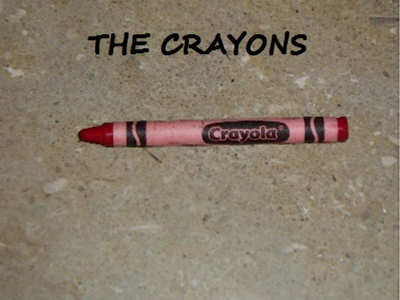
The crayons
The Crayons is a sad and disturbing tale from Japan about a young couple who buy a house that comes complete with an unsolved mystery.
A married couple, who had just returned from their honeymoon, decided to buy a house. The couple were very happy because they managed to get the house at a very cheap price. It was in a nice neighborhood, close to the city and just a short walk from a shopping center.
One day, the husband was walking down the hall when he spotted a red crayon lying on the floor. The couple didn’t have any children, so the husband wondered where the crayon had come from.
“Perhaps the previous residents left it behind”, he said to himself as he casually threw it in the trash.
The next day, the husband came home from work to find another red crayon lying in exactly the same spot. He was very puzzled and decided to ask his wife about it.
The wife grew pale in the face when he brought it up. She told him that, every day since they first moved into the house, she had been finding red crayons when she was cleaning. They were always lying in the same spot, at the end of the hallway.
The husband was standing in the hallway, wondering about this weird phenomenon, when he began to notice something was not quite right. The hallway was too short.
He tapped on the wall at the end of the hallway and heard a hollow sound. Curious, he began peeling off the wallpaper, despite the protests of his wife.
Behind the wallpaper, they found a pair of sliding doors. It was as if someone had carefully hidden the entrance to a closet or a small room.
The husband discovered that the sliding doors had been nailed shut. He got a hammer from his toolbox and began prying out the nails, one by one.
After pulling out the last nail, he slowly opened the sliding door to reveal the small hidden room. Looking inside, they saw that the white walls of the little space were covered with words scribbled in red crayon.
Over and over again were the words “mommy im sorry let me out mommy im sorry let me out mommy im sorry let me out…”
I got this story from scaryforkids.com
Wednesday, May 11, 2011
History of Haiku
I haven't posted in so long. I've been working on the MangaOption! game, which is now turning out to be more like a visual novel. The first chapter should be up soon! Anyway.... I had to do a project in school, I chose to do it on Haiku!
“Lightning flash—
what I thought were faces
are plumes of pampas grass.”
what I thought were faces
are plumes of pampas grass.”
-Basho
What is Haiku? Is it simply a poem with three lines in it? Would you ever associate Haiku with the spirituality of Buddhism? Haiku is so much more than just a poem. Many people can write Haiku, but not many people can tell you how Haiku came to be. Haiku is an extremely short type of Japanese poetry that can take years to master. Haiku has three lines, and seventeen syllables with a 5-7-5 syllable count. The poem tries to focus on one significant moment in time. In the Haiku above, written by Basho, he tries to focus in on a lightning flash.
Haiku is closely related to the spirituality of Buddhism, and Yugen. Yugen is an appreciation of beauty and art in Japan. Yugen suggests things, and doesn’t state them directly, much like a Haiku. Only a few words can suggest the true meaning of what hasn’t been said. It aims to open up inner thoughts and feelings. It focuses on one particular moment, and describes it just enough to understand, but little enough so it is open to interpretation. Because everything in Haiku is usually suggested, it can take years and years to master this Japanese art form.
Haiku is taken from another Japanese form of poem, tanka. Tanka is a poem made up of the rhyme scheme 5-7-5-7-7. Most tanka was written to explore the themes of religion or being proper. It was a popular thing to link tanka verses together. One person would write the first line of 5-7-5, and the next person would write the next 7-7 line of the poem. After that, the poem would continue in a constant line of 5-7-5-7-7, 5-7-5-7-7. Lines of a tanka could go on for thousands and thousands of lines of poetry. Linking the verses was known as renga.
Hokku (hok-oo) is the starting line in Haiku (in Japanese, Hokku literally means,”starting verse”. Hokku starts the theme and the tone for the rest of the short poem. Authors of hokku were greatly respected among other poets. Masaoka Shiki (1867-1902) was mainly responsible for hokku being read as a single poem, even shorter than haiku. Hokku is where the word haiku comes from.
Basho, Buson and Issa lived in Japan’s Edo Period; the Edo period was from 1600 – 1868. They were considered great masters of Hokku. Their work still influences how people write haiku today. They were born in rural villages. All of them spent years perfecting their poetry. They were poet-wanders. Poet-wanders roam around the land, and try to experience the words they write before they are written, a long Japanese tradition.
Basho is the father of Haiku. When he was young, he studied Taoism and classical Chinese poetry. When he first began to write poetry, he only wrote according to the “rules” of writing poetry. Japanese poetry at that time had an elegant, refined style. Basho eventually broke free of these “rules” and became a poet-wanderer. He kept a journal of many of the things that he experienced.
Today, Haiku is still one of the popular forms of poetry to write. Even today, many people are still influenced by haiku. The poem is short, and yet so full of meaning, many people read haiku to get caught up in a single moment and try to understand it. In almost every country there is a haiku society. There are many books and websites all about haiku. Many English speakers have adapted haiku writing to their own style and have changed things in the traditional form to fit their form of a haiku, like using things in the poem that are common today, but would not have been common when haiku was first made. English also has very different grammar and words than Japanese, and an English haiku with seventeen syllables can sound like they’re saying to much.
One of the most important aspects of haiku is that it aims to capture a satori (a single, amazing moment). Haiku contains simple, and direct language, and not abstract words. Haiku contains a kigo, a kigo is an image of nature that is usually in the first or third line.
Basho Wednesday, April 6, 2011
Why you should learn Kanji meaning before the Reading.
Meaning before Reading.
I have found, when studying Kanji that knowing the meaning before the reading has helped me much more than just seeing this: 本 and then the computer or textbook says THIS MEANS HON! THIS CAN BE USED IN THIS AND THIS AND THAT AND THIS.... and so on.
It's intimidating.
Your brain works better when you can connect things, and if you learn the meaning before the reading, then your brain can connect it better to other things and you will remember it longer.
I recommend:
Remembering the Kanji by James W. Heisig
Vol 1.: http://www.amazon.com/Remembering-Kanji-Vol-Complete-Characters/dp/0824831659/ref=sr_1_2?ie=UTF8&qid=1302147088&sr=8-2
Vol 2.: http://www.amazon.com/Remembering-Kanji-Vol-Systematic-Characters/dp/0824831667/ref=pd_bxgy_b_img_b
Vol. 3: http://www.amazon.com/Remembering-Kanji-Characters-Upper-Level-Proficiency/dp/0824831675/ref=sr_1_2?ie=UTF8&s=books&qid=1302147215&sr=1-2
Kanji de Manga by Glenn Kardy and Chihiro Hattori
http://www.amazon.com/Kanji-Manga-Special-Box-Set/dp/492120506X/ref=sr_1_2?s=books&ie=UTF8&qid=1302147252&sr=1-2
Kanji in Mangaland by Marc Bernabe, Veronica Calafell, Alberto Aldarabi, and Gea Cassinelo
http://www.amazon.com/Kanji-MangaLand-1-Marc-Bernabe/dp/4889962212/ref=sr_1_11?s=books&ie=UTF8&qid=1302147252&sr=1-11
BONUS!!!!!!!!!!!!!!!!!! (*sigh* once again... I try.... I think everyone who reads to the end should get a reward)
Remembering the KANA!
http://www.amazon.com/Remembering-Kana-Reading-Japanese-Syllabaries/dp/0824831640/ref=sr_1_1?ie=UTF8&s=books&qid=1302147525&sr=1-1
Hope this helped anyone who wants to learn Kanji, and... Kana!
Monday, March 7, 2011
はじめまして!
私のなまえは二コルです。
Hello! Hajimemashite! Welcome to Japan Ai. This is my blog about Japan. I'll post everything I fing about Japan here. Japan is an amazing place with a rich history. I love looking at everything Japanese. If your wondering, this is not an 'アニメおたく' blog (anime otaku) (In the nicest words, otaku means 'obsessed'). I do enjot watching anime, I may even post some anime things sometimes. Anime's not bad. I love anime. But even before I knew what anime was, way back; way, way back when I was very young I was always interested in Asian history and culture, primarily Japan.
What I named this website after:
Okay, so I was looking for a 'witty' saying to name this blog, I would have thought that this title would already be taken, but I have it now. : )
I found this:
I thought the title was very clever, so I 'stole' it. Well, anyway, whatever I find I'll post here.
Subscribe to:
Posts (Atom)

